This site uses cookies to provide you with a more responsive and personalized service. By clicking "Accept," you agree to the use of cookies on this site. Please read our Cookie Policy and Privacy Policy for more information on the use of cookies on this website.
Safety of GENGLYCOS was evaluated in 3 clinical studies1
Fifty-two (52) patients with GSDIa received a single intravenous infusion of GENGLYCOS in 3 clinical studies1
- The safety population consisted of patients from the pivotal phase 3 study, a dose-finding phase 1/2 study, and a long-term follow-up study1
- Forty-nine (49) patients received the recommended dose of 1.0 x 10¹³ genome copies per kilogram (gc/kg), and 3 patients received a lower dose1
- Patients ranged in age from 8 to 57 years old (37 adults, 15 pediatric) at enrollment1
- Median duration of follow-up was 2.1 years (range: 1.0 to 5.9 years)1
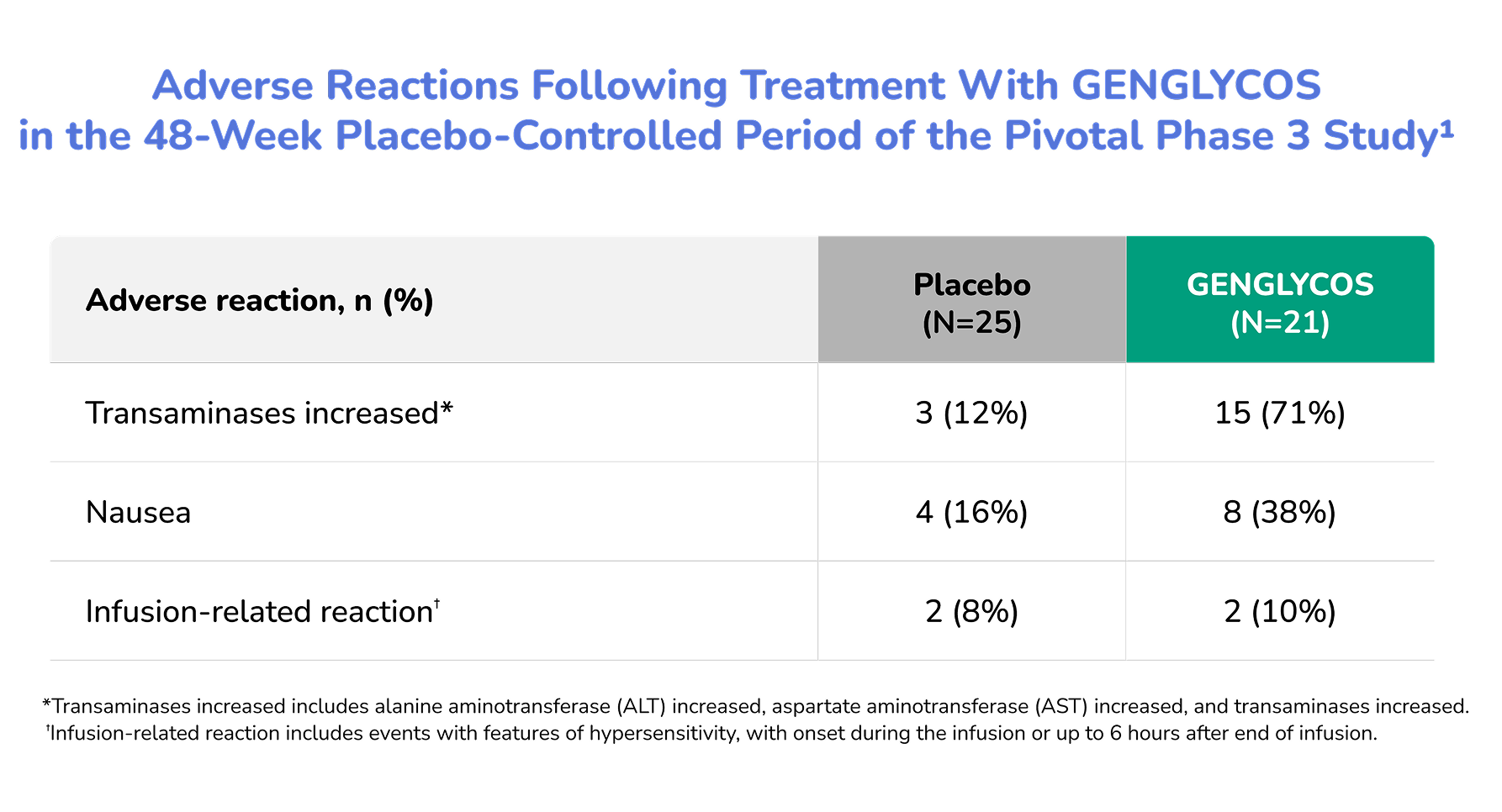
The most frequently reported adverse reactions in clinical studies were elevated transaminases (85%) and nausea (29%).1 Adverse reactions following treatment with GENGLYCOS in the 48-week placebo-controlled period of the pivotal phase 3 study are listed in the table below.1
Infusion-related reactions1
- In clinical trials (cumulative enrollment N=52), serious infusion-related reactions including hypersensitivity occurred in 2 (3.8%) patients treated with GENGLYCOS. Symptoms included chest pain, vomiting, tachycardia, and urticarial rash in one patient and coughing, difficulty breathing, and reticular rash in the other patient. Hypotension was not reported. Time to onset was 1 to 6 minutes after start of infusion. The infusions were permanently discontinued. The infusion-related reactions resolved within 2 to 8 hours without clinical sequelae.
- In the pivotal phase 3 study, after patients (N=17) were administered GENGLYCOS in accordance with dosing recommendations including premedication and a slower starting infusion rate with gradual increasing rates, there were no events of infusion-related reactions.
Elevated transaminases1
- In clinical trials (cumulative enrollment N=52), treatment-emergent adverse reactions of elevated transaminases occurred in 44 (85%) patients treated with GENGLYCOS. Eighteen (18) patients had alanine aminotransferase (ALT) and/or aspartate aminotransferase (AST) elevations ≥3× upper limit of normal (ULN) (or ≥3x baseline level if ALT or AST is greater than the ULN at baseline) and 2 patients had ALT ≥8× ULN. Most ALT and/or AST elevations occurred within the first year, especially within the first 15 weeks after GENGLYCOS administration.
- Some patients required additional corticosteroids or prolongation of the prophylactic corticosteroid regimen. Transaminase elevations usually resolved with corticosteroid treatment within 4 weeks of onset, and patients recovered without clinical sequelae.
Please see additional Important Safety Information and the full Prescribing Information.

Enrollment Form

To initiate treatment with GENGLYCOS, complete the Enrollment Form with your patient.
Patient Enrollment FormINDICATION AND IMPORTANT SAFETY INFORMATION
Indication
GENGLYCOS (pariglasgene brecaparvovec-xxxx) is an adeno-associated virus (AAV) vector-based gene therapy indicated for the treatment of adult and pediatric patients 8 years and older with glycogen storage disease type Ia (GSDIa) without detectable antibodies to adeno-associated virus serotype 8 (AAV8).
Important Safety Information
GENGLYCOS is contraindicated in patients with known severe hepatic fibrosis or cirrhosis.
Infusion-Related Reactions
- Infusion-related reactions, including hypersensitivity reactions, occurred during GENGLYCOS administration.
- Premedicate with acetaminophen and non-sedating antihistamines and administer GENGLYCOS according to recommended infusion rates. Monitor patients during and after completion of GENGLYCOS infusion as clinically indicated. In the event of an infusion-related reaction, pause the infusion and provide supportive care as needed. If the infusion is paused, restart at half the prior rate after the infusion-related reaction has resolved.
Hepatic Reactions
- Predominantly mild to moderate, transient liver transaminase elevations were observed in clinical studies, most often in the first 15 weeks following GENGLYCOS administration.
- Prior to GENGLYCOS infusion, evaluate liver-related medical history and assess liver function by clinical examination and laboratory testing. Administer corticosteroids to all patients after GENGLYCOS infusion in order to mitigate hepatic reactions. Elevated transaminases may require adjustment of the corticosteroid treatment regimen, including increased dose or prolongation of the corticosteroid taper.
- Monitor transaminase levels for the first 6 months after GENGLYCOS administration. Continue to monitor transaminases in all patients who develop transaminase elevations, until transaminases return to baseline or as clinically indicated. If transaminase elevations are observed, consider all potential causes in the assessment of management for transaminase elevations, including infectious causes, alcohol, drugs, concomitant medication use, including herbal products and nutritional supplements, and worsening of underlying GSDIa, in addition to immune responses to GENGLYCOS.
- The effect of alcohol consumption on the magnitude and duration of the therapeutic effect has not been studied with GENGLYCOS treatment. Patients should be counseled on the potential risks of alcohol consumption following GENGLYCOS infusion.
Malignancy
- The integration of liver-targeting AAV vector DNA into the genome may carry the theoretical risk of tumorigenicity and may also insert into the DNA of other human body cells.
- GSDIa is associated with hepatic adenoma formation which carries a risk of transformation to hepatocellular carcinoma. Therefore, monitor patients with annual liver imaging, in particular patients with additional or other risk factors for hepatocellular carcinoma (e.g., hepatitis B or C, non-alcoholic fatty liver disease, chronic alcohol consumption, non-alcoholic steatohepatitis, advanced age). In the event that a malignancy occurs, contact Ultragenyx Pharmaceutical Inc. at 1-888-756-8657.
Adverse Reactions
- The most frequent adverse reactions in clinical studies were transaminases increased (85%) and nausea (29%).
Contraception
- Women of childbearing potential should use effective contraception for at least 48 weeks after administration of GENGLYCOS.
- For 6 months after administration of GENGLYCOS, men must not donate semen, and men of reproductive potential and their female partners must prevent or postpone pregnancy using an effective form of contraception.
Monitoring Nutritional Intake, Glycemic Control, and Metabolic Control
- Inform patients/caregivers of the importance of continued follow-up with their healthcare provider to monitor and adjust cornstarch and diet after receiving GENGLYCOS. At home, blood glucose should be monitored to avoid hypoglycemia and maintain normal blood glucose levels. Blood tests and dietary assessments may be needed to evaluate the appropriateness of nutritional modifications (cornstarch and diet) and to ensure glycemic and metabolic stability.
Vector Shedding
- As temporary vector shedding of GENGLYCOS occurs primarily via bodily waste, patients and caregivers should be instructed to follow appropriate hygiene precautions when handling patient waste for 3 months following GENGLYCOS infusion.
Report negative side effects of prescription drugs to the FDA. Visit www.fda.gov/medwatch or call 1-800-FDA-1088. You may also report side effects to Ultragenyx Pharmaceutical Inc. at 1-888-756-8657.
Please see the full Prescribing Information for GENGLYCOS.
ALT, alanine aminotransferase; AST, aspartate aminotransferase; GSDIa, glycogen storage disease type Ia; ULN, upper limit of normal.
Reference
1. GENGLYCOS [Prescribing Information]. Novato, CA: Ultragenyx Pharmaceutical Inc; [Month Year].